 |
 |
 |
 |
 |
 |
 |
 |
 |
 |

Project “The Art of Dialogue - learning the principles of good communication and cooperation in the changing realities of European schools"
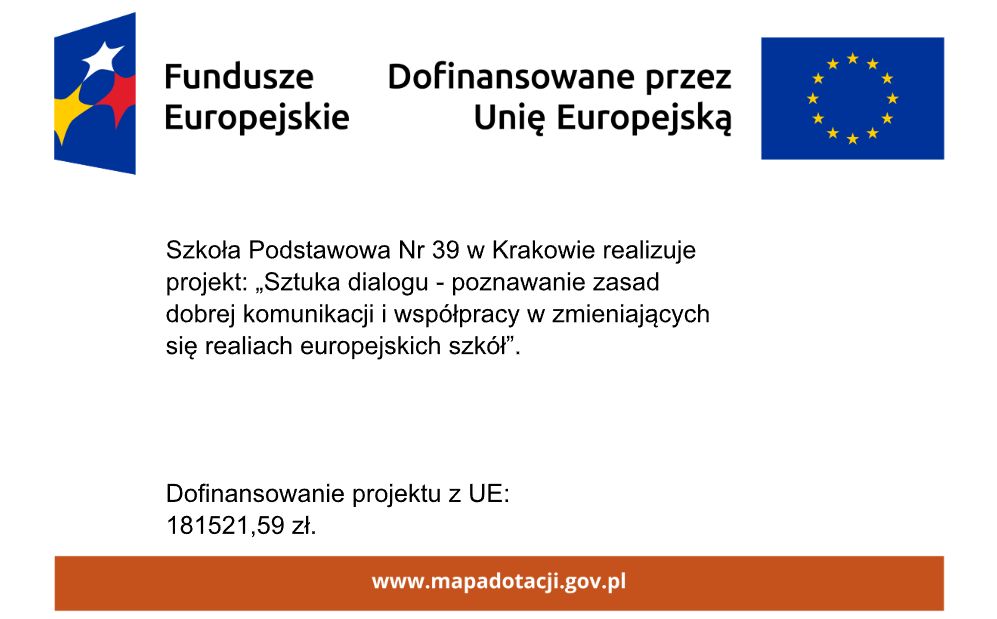
The project The project “The Art of Dialogue – Learning the Principles of Good Communication and Cooperation in the Changing Realities of European Schools” was implemented by Primary School No. 39 from September 1, 2024, to February 28, 2026, under the European Funds for Social Development (FERS) programme, operating in accordance with the principles of Erasmus+.
The school received financial support for the implementation of the project in the amount of PLN 219,972.84, of which PLN 181,521.59 came from the European Union, and the remaining amount (PLN 38,451.25) from the budget of the Republic of Poland.
The aim of the project was to enhance the communication competencies of the teaching staff in working within a multicultural environment and to support students with diverse educational needs. This initiative responded to social changes in Europe, including the influx of students with migration experience and the growing number of children requiring special support. Thanks to EU funding, it was possible to implement activities that had previously been unavailable to the school.
The target group of the project consisted of teachers from Primary School No. 39 who work in a multicultural environment and expressed an interest in and need for further training abroad in the areas defined by the project’s objectives.
A total of 21 members of the teaching staff participated in the project, representing one-third of the employees at the time of submitting the application in February 2024. They represented various specializations and levels of experience, including subject teachers as well as specialists such as school counselors and a psychologist. The project included international training (seven mobilities for methodological courses and six mobilities for language courses) in Spain, Cyprus and Malta, as well as eight job shadowing mobilities in two countries: Cyprus and Greece. All mobilities took place between the end of April and mid-August 2025, mostly during periods free from teaching duties in Polish schools, in order to avoid disrupting the school’s work by sending a large number of teachers abroad at short intervals.
Project participants developed communication, language, and intercultural competencies. Soft skills were also an important component, including the development of emotional intelligence, which is essential in the art of dialogue. The course programmes combined both theory and practice, offering guidance on how to implement new methods in everyday school practice.
The outcomes of the project include improved quality of communication within the school, better support for students, and greater openness of the staff to diversity. Cooperation with parents was also strengthened, including with families of foreign students. The project contributed to the development of inclusive education and to a lasting improvement in the functioning of the entire school community.
Teachers are now more confident and willing to engage in activities requiring the use of a foreign language, including organizing international initiatives such as workshops and exchanges abroad (England, Germany), hosting groups of foreign students implementing their EU programmes (Greece), as well as teachers coming for job shadowing from various schools, including Cyprus and Greece. All participants received certificates of participation in the training, as well as Europass Mobility documents presenting their learning outcomes.
The tangible results of our activities were presented to the wider school community in the form of presentations and reports at staff meetings, a bulletin board display dedicated to FERS, an article in the local press, and photo reports published on the school’s website.
EU funds enabled the purchase of several teaching aids in the form of educational language games, supporting communication in English, vocabulary acquisition and grammar skills. Educational board games (Let’s Talk, Scrabble and others) are used during additional classes within the Future4Me programme in grades 4–8 and serve as an inspiration for learning English.
